
How Social Enterprises Do More with Less: Introducing Bricolage

Imagine a social enterprise that wants to provide affordable healthcare in a rural community. It needs a facility, trained professionals, equipment, transport and money. But the funding available is limited.
What can it do?
It could wait until it secures more funding.
Or it could explore whether an existing community building could serve as a temporary clinic, whether local health workers could support outreach, and whether partnerships with nearby hospitals could make specialist services accessible.
The goal remains the same.
But the way the enterprise uses its resources changes.
Social enterprises often find themselves in situations like this. T
hey are expected to address complex social problems, reach underserved communities and create meaningful impact, often without the resources available to larger businesses or public institutions.
Yet, many find ways to keep going.
They combine resources, build partnerships and find new uses for things they already have. They learn to do more with less.
But this is not simply about cutting costs. It is about recognising possibilities in resources that others might overlook.
There is a concept in entrepreneurship that helps us understand this approach. It is called bricolage.
What Is Bricolage?
Bricolage is a French word associated with making, adapting or repairing things using whatever is available.
In entrepreneurship, the concept gained prominence through the work of Ted Baker and Reed Nelson. In their 2005 paper, Creating Something from Nothing: Resource Construction through Entrepreneurial Bricolage, they examined how resource-constrained firms combined available resources in new ways to address problems and opportunities.
They described entrepreneurial bricolage as making do by applying combinations of resources at hand to new problems and opportunities.
In simple terms, bricolage means finding new uses for the resources you already have instead of assuming that you need to acquire everything from scratch.
These resources are not limited to money or physical materials.
They can include
people's skills,
community relationships,
unused spaces,
existing infrastructure,
local knowledge,
volunteer networks and institutional partnerships.
For social enterprises, this idea is particularly relevant.
They may operate in environments where funding is uncertain, markets are underdeveloped and formal support systems are difficult to access.
Research has examined how social enterprises in resource-constrained settings use bricolage to overcome such barriers and create social value.
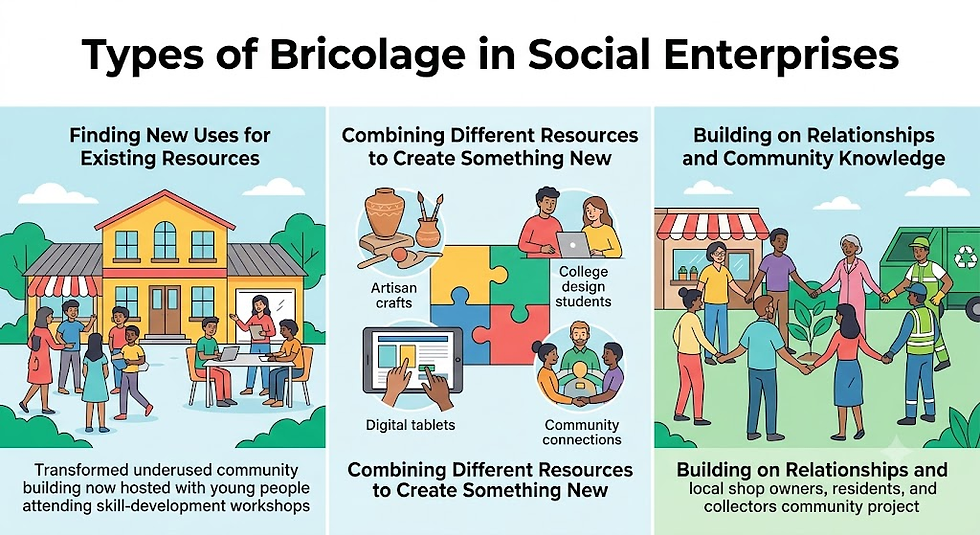
1. Finding New Uses for Existing Resources
Sometimes, a resource becomes valuable because someone sees a use for it that others have not considered.
Imagine a rural community with an underused public building. A social enterprise working with young people could explore using the space for skill-development sessions, community meetings or entrepreneurship workshops, subject to permission and practical arrangements.
The organisation may not need to construct a new centre immediately. It could begin by making better use of an existing space.
The same thinking applies to equipment, materials, vehicles and digital infrastructure. Something that is unused by one organisation might be useful to another.
The key is not merely to reuse resources, but to recognise possibilities in what is already available.
2. Combining Different Resources to Create Something New
Bricolage is also about combining resources that were not originally intended to work together.
Consider an enterprise that wants to help rural artisans reach new markets. It may not have enough money to establish physical retail outlets or hire a large sales team.
Instead, it could combine artisans' existing skills, a local college's design students, a community organisation's network and digital platforms to test a new way of reaching customers.
Each resource contributes something different. Together, they create an approach that none of them might have been able to deliver alone.
For social enterprises, this can mean combining local knowledge with technology, volunteers with professional expertise, or existing public infrastructure with community-led services.
Sometimes, the missing resource is not another asset. It is a new combination of the assets already available.
3. Building on Relationships and Community Knowledge
Not every valuable resource can be counted on a balance sheet.
Trust, relationships, local knowledge and community participation can be equally important.
Imagine a social enterprise trying to improve waste segregation in a neighbourhood. It could spend heavily on an awareness campaign, or it could work with residents' associations, local shops, schools and existing waste collectors to build a community-based approach.
These relationships can help the enterprise understand local habits, identify practical barriers and reach households more effectively.
This does not mean community participation should be treated as free labour. People contributing their time and expertise deserve recognition, and some activities require paid professionals and adequate funding.
But it does show how relationships can help organisations mobilise resources that are not available through conventional purchasing alone.
In social entrepreneurship research, this broader approach to bricolage includes the participation of stakeholders and the creation of social value—not merely improvising with physical materials.
Is Bricolage Just Another Word for Being Resourceful?
Not quite.
Being resourceful is a broad description of someone's ability to solve problems creatively. Bricolage gives us a more specific way to understand what happens when entrepreneurs make do with resources at hand, recombine them and put them to new uses.
It also differs from simply spending less.
An organisation that reduces its programme budget by cutting essential staff or compromising service quality is not necessarily practising effective bricolage. It may simply be under-resourcing its work.
Bricolage is about finding new possibilities in available resources—not pretending that resources do not matter.
And there is a limit to how far it can take an organisation. Some problems require investment in infrastructure, professional expertise, technology or long-term funding.
Constantly improvising can also place excessive pressure on employees and volunteers.
The aim should not be to build an organisation that survives forever on too little.
It should be to use available resources intelligently while identifying where additional resources are genuinely needed.
A Different Way to Look at Social Enterprises
The next time you come across a social enterprise, look beyond its product, service or impact numbers.
Ask how it is managing its resources.
Is it using an existing space in a new way? Has it combined the skills of different people to create a service? Is it building on community relationships? Has it found a productive use for something that others considered unnecessary?
You may discover that its most interesting innovation is not what it sells, but how it brings together the resources needed to make it possible.
☕ Coffee Break Question
Think of a social enterprise or community initiative you know.
What resources does it already have that could be used differently—and what new possibility might emerge if those resources were combined?
💡 One Idea to Take Home
Bricolage reminds us that resources are not valuable only because of what they were originally intended to do.
Sometimes, the opportunity lies in seeing what else they could become.
So, the next time you see a social enterprise, look at how it is managing its resources. You might find that its greatest strength is not how much it has, but what it knows how to do with what it has.
Further Reading
Baker, T., & Nelson, R. E. (2005). Creating something from nothing: Resource construction through entrepreneurial bricolage. Administrative Science Quarterly, 50(3), 329–366. https://doi.org/10.2189/asqu.2005.50.3.329


Comments