.png)
5 Differences Between Product Innovation and Process Innovation

When we hear the word innovation, many of us immediately imagine something new being created—a new machine, a new software application, a new medical device, or a completely new product.
But innovation is much broader than creating a new product.
At its simplest, innovation means introducing something new that is useful and creates value. Novelty is important, but simply being new does not make something an innovation.

Creativity can produce new ideas, but an idea becomes innovation when it is put into use and creates value.
This is why innovation is not limited to what we make.
It can also be about how we make it, how we deliver it, or how we do the work.
This gives us two important forms of innovation: Product innovation and process innovation.
What Is Product Innovation?
Product innovation refers to introducing a new or significantly improved product or service to users.
The innovation is visible in what is being offered. For example, developing a new low-cost medical device, creating a new agricultural product, or designing a software application that solves a problem in a new way can all be forms of product innovation.
The focus is on creating or significantly improving the value offered to the customer or beneficiary.
What Is Process Innovation?
Process innovation refers to introducing a new or significantly improved way of producing, delivering, managing, or carrying out an activity.
Here, the innovation is not necessarily in the product itself.
It is in how the work gets done.
For example, a hospital may continue providing the same healthcare service but introduce a new system that reduces patient waiting time. A social enterprise may sell the same product but develop a new distribution process that allows it to reach remote communities at a lower cost.
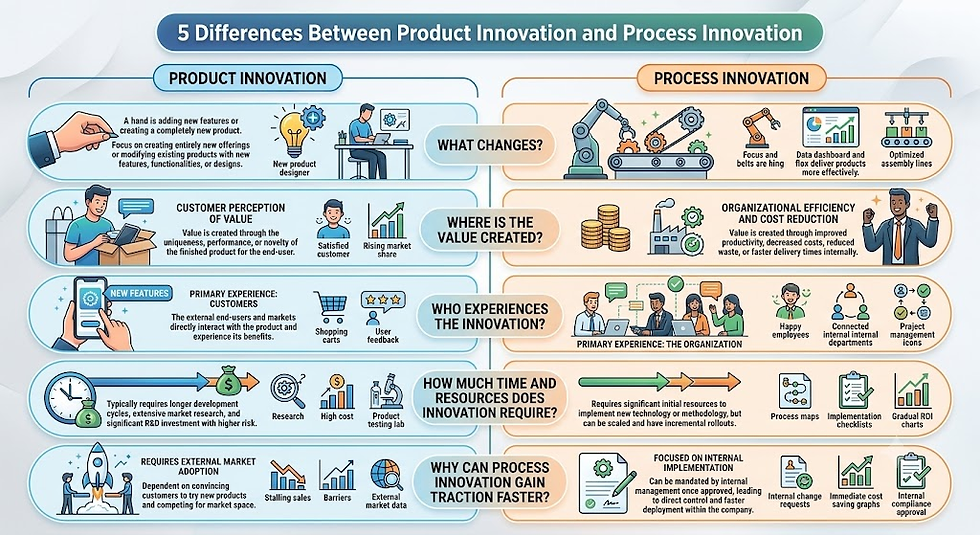
What Changes? Product Innovation vs. Process Innovation
The simplest difference is what is being changed.
In product innovation, the product or service changes.
Imagine a company that traditionally sells solar lanterns and develops a new solar-powered device specifically designed for farmers. The new offering itself is the innovation.
In process innovation, the product may remain exactly the same.
Instead, the organization might discover a better way to manufacture, distribute, or deliver the solar lanterns.
Product innovation changes what you offer. Process innovation changes how you offer it.
Where Is the Value Created? New Products vs. Better Processes
Product innovation creates value through the new or improved offering. A product may become cheaper, safer, faster, more convenient, or more effective because of the innovation.
Process innovation creates value through improving the way the organization operates. For example, a social enterprise delivering meals to elderly people may not change the meals at all. Instead, it could redesign its delivery routes and scheduling system so that the same meals reach more people using less fuel and time.
The beneficiary receives essentially the same product. But the organization has found a better way to deliver it.
Who Experiences the Innovation? Customers vs. the Organization
Product innovation is usually visible to the customer or beneficiary. They can see or experience the new product or service. Process innovation can be less visible.
A customer may not know that a company has completely redesigned its inventory system, manufacturing process, delivery route, or internal workflow. They may simply notice that their order arrives faster or that the service has become more reliable.
This is one reason process innovation can sometimes be overlooked. The innovation may be happening behind the scenes.
Process Innovation Can Require Less Time
Developing a completely new product can take significant time. There may be research, prototyping, testing, manufacturing, marketing and user adoption involved.
Process innovation can sometimes happen much faster because the organization is improving something that already exists.
For example, a community organization may already conduct field surveys using paper forms. Instead of creating a completely new service, it could introduce a digital data-collection system that reduces duplication and speeds up reporting.
The organization has not invented a new service.
It has innovated the process through which the existing work is carried out.
This does not mean every process innovation is quick or inexpensive. Some process changes—particularly in manufacturing, healthcare or large organizations—can require substantial investment.
But compared with creating an entirely new product, process innovation can often provide a faster route to improvement.
Process Innovation Can Gain Traction More Easily
A new product asks the customer to try something new. That can take time.
People may not understand the product, trust it, or immediately see why they need it. Process innovation can sometimes avoid this barrier.
Imagine a social enterprise already providing an affordable healthcare service. Instead of introducing a completely new service, it changes its appointment system so that patients can book through community workers or a simple digital platform.
The patient is still receiving the healthcare service they already understand.
The organization has simply made the experience easier.
Because the end product or service remains familiar, process innovation can sometimes gain traction more easily.
☕ Coffee Break Question
Think about a product or service you use regularly.
If you could not change the product itself, what process around it would you change to make the experience better?
💡 One Idea Home
Innovation is not only about creating something new. Sometimes, innovation is simply finding a better way to do something that already matters.


Comments