
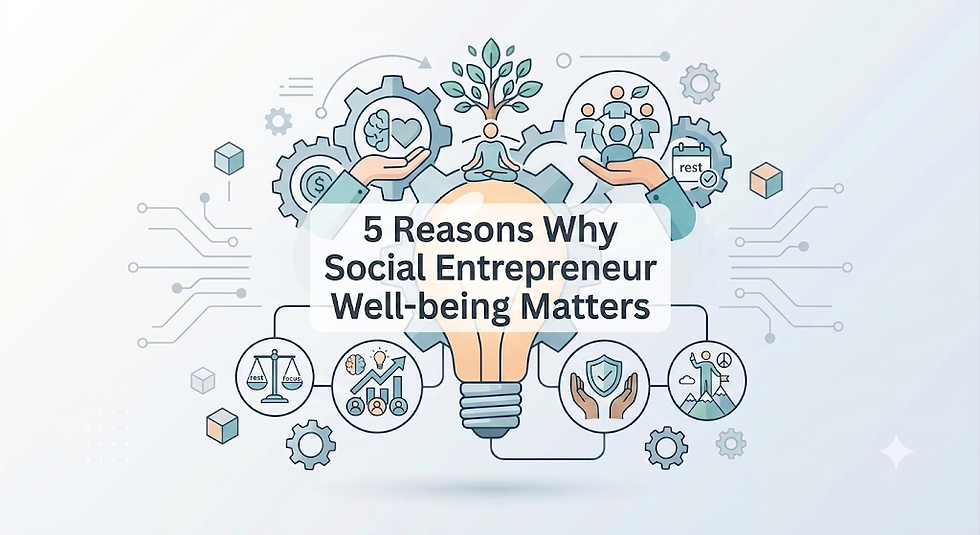
5 Reasons Why Social Entrepreneur Well-being Matters
There is an unwritten rule in social entrepreneurship that we rarely talk about. To be a committed changemaker, you are expected to sacrifice.
Miss a meal because there is a project deadline.Work late because a grant proposal has to go out.Travel constantly because the community needs you.Ignore exhaustion because there is still more work to do.
Somehow, being tired becomes a sign that you care.
But here is the problem:
Exhaustion is not a strategy for social impact.
As a social entrepreneur, it is easy to convince yourself that your own well-being can wait. There is always another community to serve, another project to complete, another funding opportunity to pursue, and another problem that needs attention.But social change is not a sprint.
And if the person leading the work burns out, the mission suffers too.
The "Scale at All Costs" Trap
The pressure to go bigger is everywhere.
More beneficiaries.More projects.More districts.More funding.More partnerships.
Scaling can be important. But when scale becomes the only measure of success, social entrepreneurs can start compromising their own well-being to keep up.
Skipping meals, ignoring exhaustion, sacrificing sleep, and constantly being available may help you get through a difficult week.
But what happens when that week becomes a year?
Well-being is not something that comes after impact. It is part of the infrastructure that makes sustained impact possible.
Here are five reasons why it matters.
1. Well-being Helps Prevent Burnout
Social entrepreneurship can be demanding.
You may be dealing with funding uncertainty, regulatory requirements, grassroots challenges, team management, and the emotional weight of working on difficult social problems.
Operating constantly at the edge of physical and emotional exhaustion makes all of this harder.
Burnout is not simply a personal failure. It can also be a structural hazard in organizations where people are expected to continuously do more with limited resources.
Protecting your physical energy and mental space is therefore not a luxury. It is a form of risk management.
When a crisis comes, a rested and healthy leader is more likely to have the resilience to respond than someone who has already been running on empty for months.
You cannot remove every challenge from social entrepreneurship. But you can avoid making exhaustion another challenge you have to manage.
2. We Need to Move Beyond the "Hero" Culture
There is a romantic idea of the social entrepreneur as a person who carries everything on their shoulders.
The founder who never stops.
The person who responds to every message.
The person who is always the first to arrive and the last to leave.
Fatigue becomes a badge of commitment.
But social change should not depend on one person's ability to keep sacrificing themselves.
The real question is not:
"How much can I personally carry?"
It is:
"How can we build a system where the work does not depend entirely on one person?"
Sustainable leadership means moving from individual heroics towards resilient teams, systems, and institutions.
You don't have to be the person who solves everything.
Your job as a social entrepreneur is also to build something that can continue without you carrying every part of it.
3. A Rested Mind Is Better at Solving Complex Problems
Social problems are rarely simple.
There is usually no single cause, no single solution, and no quick answer.
Solving them requires creativity, patience, listening, and the ability to look at a problem from different perspectives.
Constant stress and lack of rest can make us reactive.
Instead of asking, "What is really happening here?", we start asking, "How do I get this done as quickly as possible?"
That difference matters.
A social entrepreneur needs the mental space to notice when an approach isn't working, listen to communities, question assumptions, and change direction when necessary.
Sometimes the best thing you can do for a difficult problem is step away from it for a while.
A rested mind does not guarantee a good solution. But an exhausted mind makes good problem-solving harder.
4. Your Team Learns From How You Work
Organizational culture is often shaped by what leaders do, not what they say.
Imagine a founder who tells the team:
"Take care of yourselves. Don't work late."
But then sends messages at 2 a.m., skips holidays, never takes leave, and expects everyone to respond immediately.
The team notices the behaviour, not the advice.
If a social entrepreneur constantly models exhaustion, team members may begin to believe that overwork is simply part of working for a social cause.
Over time, this can contribute to fatigue, disengagement, and high turnover.
But when leaders set reasonable boundaries, take rest, delegate responsibilities, and acknowledge that people have lives outside work, they communicate something equally important:
You can care deeply about the mission without sacrificing your entire life to it.
That can help create a healthier and more sustainable organizational culture.
5. Social Change Is a Marathon, Not a Sprint
Think about the problems social enterprises are trying to solve.
Poverty doesn't disappear in a year.
Gender inequality doesn't disappear because of one project.
Climate change isn't solved by one campaign.
Improving healthcare, education, livelihoods, or communities can take decades.
So why should we expect the people working on these problems to operate as if they have only a few months to finish?
The work of social change is inherently long-term.
That makes longevity one of a changemaker's greatest assets.
If you protect your well-being today, you increase the possibility that you will still be there years later—to learn, adapt, lead, mentor others, and see the changes you helped create.
The goal isn't to work less simply for the sake of working less. The goal is to build a way of working that you can sustain.
Well-being Is Part of the Mission
Social entrepreneurs often think about sustainability in terms of money.
Can we generate enough revenue?
Can we raise enough funding?
Can the organization survive?
These are important questions.
But there is another question we should ask:
Can the people doing the work sustain themselves?
An organization with a financially sustainable model but exhausted people is not truly sustainable.
Your health, energy, relationships, attention, and ability to think clearly are also resources.

So perhaps it is time to stop treating the well-being of the changemaker as something separate from social impact.
You are not the cost of creating impact. Your well-being is part of the infrastructure that makes impact possible.
☕ Coffee Break Question
If your social enterprise had to continue for the next 20 years, what is one thing about the way you currently work that you would need to change?
Not for productivity. Not for scale. For sustainability—for you and the people working with you.


Comments