.png)
Start Small, Build Smart: Why First Experiments Matter in Social Entrepreneurship
What if your idea is bigger than what you can do right now?
Imagine! You want to improve education in your village. But you don't have funding. You don't have a large team. You don't have an office. And you certainly don't have a ten-year plan.
Does that mean you are not ready to start?
Not necessarily.
Many entrepreneurial ventures, including some well-known social enterprises, did not begin with a detailed business plan or a clearly defined long-term strategy.
They began with something much smaller—a personal experience, an observation, a few people, a little money, or simply a strong desire to do something about a problem.
The important thing was that someone started.
Big Ideas Can Have Very Small Beginnings
Take Grameen Bank.
A pioneering microfinance institution from Bangladesh that provides small loans to people who have limited access to conventional banking. Founded by economist Muhammad Yunus, it became widely known for using microcredit to support low-income communities, particularly women.Its beginnings can be traced to Professor Muhammad Yunus making a few personal loans to poor people in a nearby village.
What eventually became a globally recognized model of microfinance did not begin at a global scale. It started with a few people.
Or look at SEWA.

The Self-Employed Women’s Association (SEWA) is a trade union and organization working with women in India’s informal economy. It supports women workers through collective organizing, financial services, livelihoods, social security, and access to markets. Its roots can be traced to Ela Bhatt’s work with unorganized women workers in Ahmedabad.The roots of the organization can be traced to Ela Bhatt's interaction with women working in the informal sector. She encountered a problem faced by a group of workers and began responding to it. The larger organization emerged over time.
This pattern appears again and again.
CRY (Child Rights and You) began in 1979 when 25-year-old Rippan Kapur and six friends pooled ₹50 each because they wanted to "do something" for underprivileged children.
₹50 from each person. That was the beginning.
CRY is an Indian organization working to protect and promote the rights of children, particularly those facing poverty and exclusion. Its work focuses on areas such as education, healthcare, protection from violence, and child participation.The organization that followed became much larger than that initial contribution. But the people involved didn't need to raise crores of rupees before they could take their first step.
Goonj Started with 67 Unused Clothes

Sometimes, the beginning isn't even a carefully designed social intervention.
It can be something you notice in your own life.
Goonj is an Indian organization that works on development and community-led solutions by turning surplus material, particularly clothing, into a resource for communities. Its work connects urban surplus with rural and marginalized communities while using material as a starting point for broader development initiatives.Anshu Gupta and his wife, Meenakshi, discovered that just three years after their marriage, they had 67 surplus clothesthat were lying unused. That simple observation led them to think differently about clothing and its relationship with poverty and dignity. Eventually, this became Goonj, which developed a much larger approach to using surplus material as a resource for development work.
An opportunity can emerge from paying attention to something that others might simply ignore.
Sulabh Began with Six Toilets
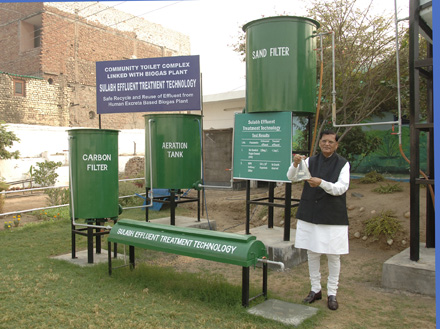
Consider another example: Sulabh.
Sulabh International is an Indian organization known for its work in sanitation, particularly affordable and accessible toilet and sanitation systems. It developed the pay-and-use public sanitation model and has worked extensively on improving sanitation and hygiene across India.Dr. Bindeshwari Pathak received a grant of just ₹500 from the municipal commissioner of Ara in Bihar to construct six toilets.
Starting small does not mean starting carelessly.
Planning becomes important as an initiative grows. You need to understand the problem, think about resources, test assumptions, manage finances, build a team, and eventually develop a sustainable model.
But sometimes young changemakers spend so much time trying to create the perfect plan that they never actually begin.
They want the perfect team.
The perfect funding.
The perfect project design.
The perfect name.
The perfect five-year strategy.
Meanwhile, the problem they wanted to solve remains exactly where it was. Perhaps a better approach is to start with something manageable.
Want to improve career guidance in your village? Don't begin by trying to reach every student in the district. Start with one school.
Starting small is not the same as thinking small.
The size of your first action does not determine the size of your eventual ambition. In fact, starting small can make a big ambition more realistic.
Every small project gives you evidence, relationships, learning, and credibility. Over time, these can become the foundation for something much larger.
The examples of Grameen Bank, SEWA, CRY, Goonj, Sulabh, Nike, and even Facebook remind us of something simple:
Many things that look obvious in hindsight were once very small beginnings.
So, if you are waiting until you have enough money, people, knowledge, or certainty to begin, perhaps the better question is: What is the smallest thing you can do today?
Start there.
Learn from it.
Then take the next step.
☕ Coffee Break Question
Think about one social problem you genuinely care about.
If you had only ₹1,000, one week, and three people to work with, what would you try?
Don't design the perfect solution.
Just think about what you could start.


Comments