.png)
Business Model Canvas: The One-Page Plan Every Social Entrepreneur Should Know

Updated: Jul 15
This article is written by Prashik and Jaseel, who were roommates while pursuing their Master's in Social Innovation and Entrepreneurship at the Tata Institute of Social Sciences (TISS). They co-learned about social enterprises and business models together. The authors would like to thank Dr. Sri Krishna Sudheer, faculty at TISS, for his lectures and guidance.
Imagine someone asks you:
"Can you explain your entire social enterprise on just one page?"
No lengthy business plan. No 50-page proposal. Just one page. Sounds difficult?
That is exactly why the Business Model Canvas (BMC) was created.
For entrepreneurs, a Business Model Canvas is like a roadmap. Just as a map helps travellers understand where they are going before starting a journey, a Business Model Canvas helps entrepreneurs understand how their idea will work before investing time, money, and effort.
It answers a few simple but powerful questions:
Who are we serving?
What problem are we solving?
How do we deliver our solution?
Who will help us?
How will the organization sustain itself financially?
Instead of writing hundreds of pages, entrepreneurs can see their entire business model on a single sheet.
The Business Model Canvas was developed by Alexander Osterwalder as part of his research on business models. It gained worldwide recognition after the publication of Business Model Generation, co-authored by Alexander Osterwalder and Yves Pigneur.
The idea was simple but revolutionary:
Instead of describing a business through long reports, why not visualize it using nine building blocks on a single page?
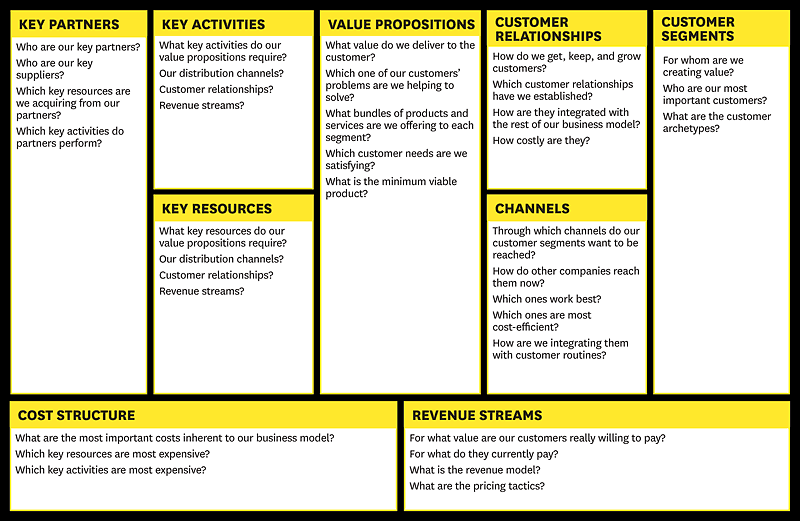
Today, startups, businesses, incubators, and innovation centres around the world use the Business Model Canvas to design and improve their ideas.
Imagine a social enterprise providing healthcare services in rural villages.
The Business Model Canvas may look something like this:
Customer Segments: Rural patients, elderly people, farmers
Value Proposition: Affordable doorstep diagnostic services
Channels: Community health workers and mobile technology
Customer Relationships: Regular follow-ups and local trust
Revenue Streams: Affordable service fees, CSR partnerships, grants
Key Resources: Medical staff, diagnostic equipment, technology
Key Activities: Sample collection, testing, awareness programmes
Key Partnerships: Hospitals, laboratories, NGOs, local healthcare practitioners
Cost Structure: Salaries, transportation, equipment, technology
By filling these nine blocks, the entrepreneur gains a clear picture of how the organization will operate.
Is the Traditional Business Model Canvas Enough for Social Enterprises?
The Business Model Canvas is an excellent planning tool.
However, there is something important that every social entrepreneur should know.
The traditional Business Model Canvas was originally designed for commercial businesses.
Its primary focus is on creating value for customers and building a financially successful business.
For most businesses, this works perfectly.
But social enterprises operate differently.
A traditional business may ask:
How can we sell more products?A social enterprise asks:
How can we solve a social problem while building an organization that can sustain itself?Social entrepreneurs need to think beyond customers and revenue.
They also need to think about beneficiaries, communities, social impact, and long-term change.
This is where adaptations of the Business Model Canvas become valuable.
The Portales Social Business Model Canvas
Recognising that social enterprises have different priorities, researchers have developed modified versions of the traditional Business Model Canvas.
One of the most widely discussed adaptations is the Social Business Model Canvas proposed by Luis Portales.

While the traditional Business Model Canvas focuses primarily on how a business creates and captures economic value, the Portales Canvas expands the discussion by placing social value creation at the centre.
It encourages entrepreneurs to ask additional questions such as:
Who are the beneficiaries?
What social problem are we solving?
What impact are we creating?
Which stakeholders are involved?
How can financial sustainability support social impact?
Rather than treating profit as the ultimate goal, the Portales Canvas views financial sustainability as a means of achieving lasting social change.
If your goal is to build a commercial business, the traditional Business Model Canvas is an excellent tool.
If your goal is to solve a social problem while remaining financially sustainable, frameworks such as the Portales Social Business Model Canvas can provide a broader perspective.
Why Should Social Entrepreneurs Learn the Business Model Canvas?
The Business Model Canvas remains one of the most useful tools for anyone starting a social enterprise because it helps entrepreneurs:
Convert ideas into clear action plans.
Identify strengths and gaps in their business model.
Test and improve ideas quickly without writing lengthy business plans.
Communicate their ideas clearly to partners, funders, and team members.
Build organizations that balance impact with sustainability.
Whether you use the traditional Canvas or an adapted version, the exercise of thinking through your business model can save significant time, effort, and resources.
One Idea to Take Home
A business model is not just about making money. It is about understanding how your organization creates, delivers, and sustains value.
For social entrepreneurs, that value is measured not only in revenue, but also in the lives and communities they improve.
☕ Coffee Break Question
Imagine you have only one page to explain your social enterprise.
Would most of that page describe your product...
...or the social problem you are trying to solve?
Your answer might reveal whether your enterprise is driven more by the solution or by the mission.


Comments